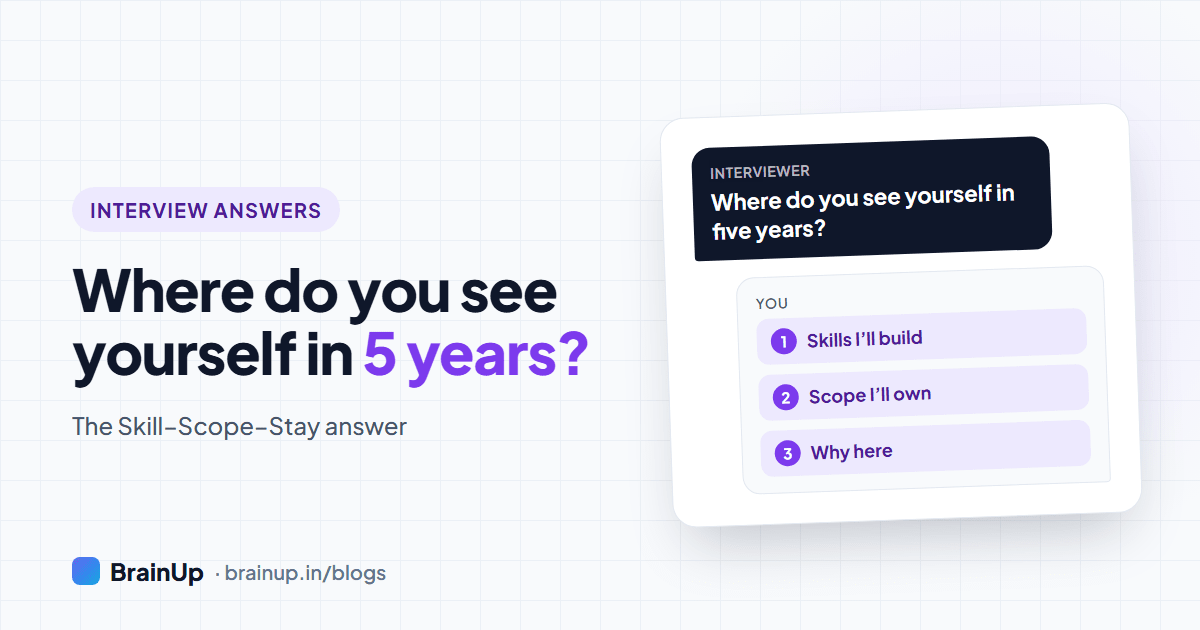
Short answer: Describe the skills you want to master and the responsibility you want to grow into, then explain why this role and company are a good place to do it. Avoid specific job titles, salary figures and plans that suggest you will leave soon.
Nobody really knows where they will be in five years, and the interviewer knows that too. So why do they keep asking? Because your answer reveals three things quickly: whether you have thought about your career, whether this job fits that direction, and whether you are likely to stay.
A good answer is short, honest and pointed at the role in front of you. Here is how to build one.
The Skill–Scope–Stay method
| Part | Question it answers | Example phrase |
|---|---|---|
| Skill | What will you be good at? | “I want to be someone the team relies on for…” |
| Scope | What will you be responsible for? | “…owning a full module / a set of clients / a process.” |
| Stay | Why here? | “This role gives me… which is why I applied.” |
Notice what is missing: job titles. “Team Lead in three years” sounds rigid, and promotion timelines vary wildly between companies. Skills and scope sound ambitious without boxing you in.
Turning a title into skills and scope
“In five years I see myself as a Senior Manager.”
“In five years I want to be the person who can take a client project from brief to delivery and guide two or three newer team members while doing it.”
Sample answers
These are illustrative. Adapt the details to your real field and goals.
Fresher (software developer)
“In five years I want to be a strong backend developer: comfortable designing APIs, writing tests that catch real bugs, and understanding how our systems behave in production. I’d like to own a service end to end and help onboard new joiners. Your team works on high-traffic systems with code reviews and mentoring, which is exactly where I want to build those skills.”
Fresher (non-technical, operations)
“I want to understand operations deeply: how orders, inventory and vendors connect. In five years I’d like to be managing a process on my own and improving it with data. Starting here, in a growing supply chain team, gives me the exposure to learn that properly.”
Experienced (marketing executive, 4 years)
“Over the next five years I want to move from running campaigns to owning a channel’s strategy and budget, and to be confident reporting results to leadership. This role puts paid and organic under one team, which is the broader view I need to get there.”
Career switcher (moving into data analysis)
“I’ve moved into analytics deliberately, so my five-year goal is depth: being strong in SQL and modelling, and combining that with the finance background I already have. I’d like to become the analyst finance teams trust for their numbers. This role sits right at that intersection.”
When your plans are genuinely uncertain
Maybe you are considering higher studies, a government exam or your own startup. You do not have to reveal everything, but do not lie either.
- If the plan is far away or undecided, leave it out and focus on what you want to get good at.
- If it is relevant and long-term, mention it briefly and connect it to the role: “Eventually I may pursue an MBA, and hands-on product experience here would make that far more valuable.”
- If you are likely to leave within a year, think honestly about whether this is the right role to apply for.
Answers that hurt you
| Answer | Why it hurts |
|---|---|
| “I don’t know.” | Sounds like you have not thought about it at all |
| “In your chair.” | A cliché that can sound like a threat |
| “Running my own company.” | Signals you will leave |
| “Earning ₹X lakh.” | Money-first answers raise retention concerns |
| A goal unrelated to the job | Shows the role is a stopgap |
Variants: 3 years and 10 years
For three years, shrink the scope: one or two skills you will have mastered and one responsibility you will own. For ten years, it is fine to be broader (“leading a team or a function in this domain”), as long as the direction still runs through this kind of role.
Rehearse the whole interview
Practise career-goal questions and other common ones for your target role with BrainUp’s AI Interview Prep (beta).
Try AI Interview PrepFor more questions like this one, see our list of common interview questions and answers.
Key takeaways
- Answer in skills and scope, not job titles.
- Connect your direction to what this role offers.
- Keep it to 45–60 seconds.
- Leave out plans that suggest you will leave soon, but do not invent fake ones.
Frequently asked questions
Why do interviewers ask where I see myself in 5 years?
They want to know whether your goals fit what the role can offer, whether you have thought about your career at all, and whether you are likely to stay long enough for the hire to pay off.
What should a fresher say for “Where do you see yourself in 5 years?”
Talk about the skills you want to master in this field and the kind of responsibility you want to grow into, such as owning a module or mentoring juniors. Avoid naming a specific title or salary.
Is it okay to say I want to do an MBA or start a business?
Only if it does not conflict with the role. If you mention it, frame it as long-term and explain how the next few years in this job build toward it. If it signals you will leave in a year, keep it out of the answer.
Should I say “I want your job”?
No. It is a cliché and can come across as a threat to the interviewer. Describe the scope you want, such as leading a small team, instead.
How do I answer “Where do you see yourself in 3 years?”
Use the same Skill–Scope–Stay structure with a shorter horizon: one or two skills you will have mastered and one responsibility you will own.