Short answer: Start every resume bullet with a specific past-tense verb that describes what you actually did (built, reduced, negotiated, analysed), follow it with what you worked on, and end with the result. Pick the most accurate verb, not the grandest one, and avoid weak openers like “responsible for” and “worked on”.
Look at your resume bullets. If most of them begin with “Responsible for”, “Worked on” or “Helped with”, the recruiter has to guess what you actually did. Those phrases describe a job description, not your work.
The first word of each bullet carries more weight than any other, because it is the word recruiters see when they skim. A precise verb tells them in a fraction of a second whether you built, fixed, sold or led something.
The Verb–Object–Result bullet
[Action verb] + [what you worked on] + [result or scale]
“Automated the weekly sales report in Excel, cutting preparation time from 6 hours to 1.”
For the full method on writing bullets, see how to write resume bullets that show impact.
Weak words to replace
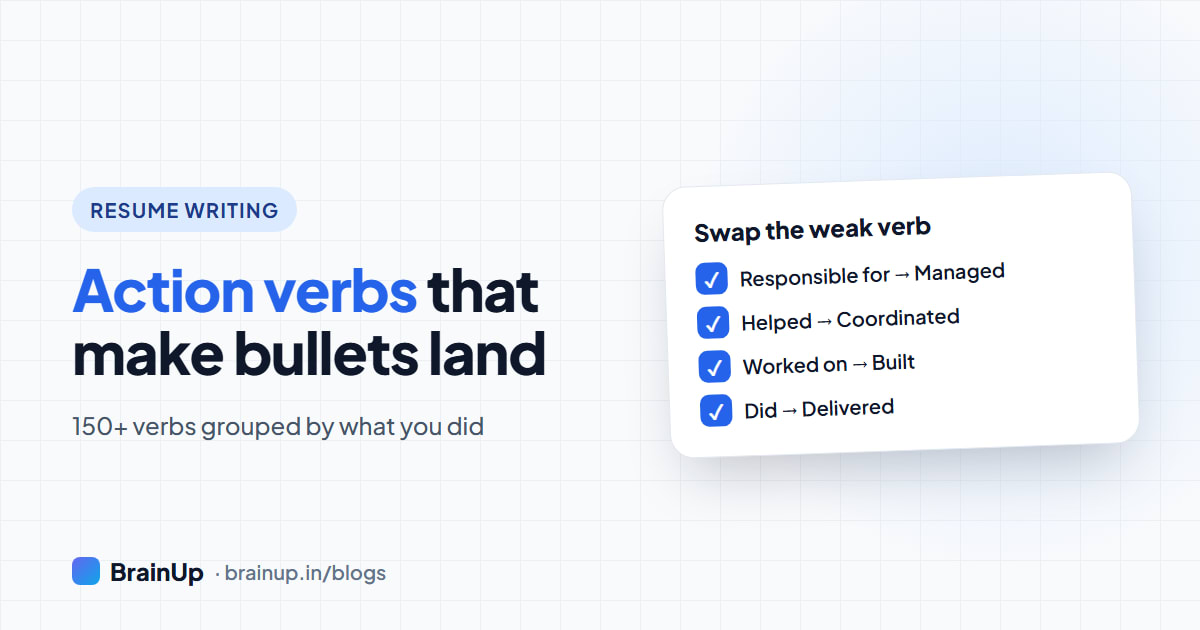
| Instead of | Try (if accurate) |
|---|---|
| Responsible for | Managed, Owned, Ran, Oversaw |
| Worked on | Built, Developed, Designed, Delivered |
| Helped / Assisted | Supported, Coordinated, Contributed to, Prepared |
| Did / Handled | Executed, Processed, Resolved, Completed |
| Made | Created, Produced, Drafted, Launched |
| Was part of | Collaborated with, Partnered with, Joined |
| Improved (vague) | Reduced [X], Increased [Y], Shortened, Simplified |
The verb accuracy ladder
Recruiters and interviewers will ask about your bullets. Choose the verb that matches your real level of ownership:
- Supported / Assisted: you helped someone else who owned it.
- Contributed / Coordinated: you owned a part, or connected people.
- Built / Delivered / Managed: you owned it end to end.
- Led / Directed / Spearheaded: you led other people doing it.
150+ action verbs by what you did
1. Built or created something
Built, Created, Designed, Developed, Engineered, Launched, Produced, Programmed, Prototyped, Set up, Wrote, Drafted, Composed, Established, Introduced
2. Improved something
Improved, Optimised, Streamlined, Simplified, Upgraded, Redesigned, Refined, Revamped, Standardised, Modernised, Restructured, Strengthened, Accelerated, Automated, Consolidated
3. Reduced cost, time or errors
Reduced, Cut, Lowered, Decreased, Eliminated, Minimised, Saved, Shortened, Prevented, Resolved, Recovered, Fixed, Debugged, Corrected, Contained
4. Grew numbers
Increased, Grew, Expanded, Boosted, Raised, Generated, Doubled, Scaled, Acquired, Attracted, Converted, Won, Exceeded, Surpassed, Achieved
5. Led people
Led, Managed, Mentored, Coached, Trained, Supervised, Guided, Directed, Hired, Onboarded, Delegated, Motivated, Mobilised, Headed, Chaired
6. Analysed and researched
Analysed, Assessed, Audited, Calculated, Evaluated, Examined, Forecast, Identified, Investigated, Measured, Modelled, Researched, Surveyed, Tested, Validated
7. Communicated and influenced
Presented, Pitched, Negotiated, Persuaded, Advocated, Briefed, Explained, Published, Reported, Documented, Authored, Edited, Translated, Facilitated, Represented
8. Organised and planned
Organised, Planned, Scheduled, Coordinated, Prioritised, Arranged, Catalogued, Tracked, Monitored, Administered, Allocated, Budgeted, Forecast, Mapped, Executed
9. Helped customers and teams
Supported, Served, Resolved, Answered, Assisted, Advised, Consulted, Counselled, Educated, Guided, Responded, Retained, Satisfied, Welcomed, Followed up
10. Sold and partnered
Sold, Closed, Prospected, Secured, Sourced, Partnered, Onboarded, Renewed, Upsold, Cross-sold, Negotiated, Networked, Cultivated, Pitched, Expanded
Before and after
Illustrative rewrites across roles.
Responsible for social media posts.
Planned and published 12 Instagram posts a month for the college fest page, growing followers from 800 to 2,400 in one semester.
Worked on the backend of an e-commerce project.
Built REST APIs in Node.js for cart and checkout in a team e-commerce project, with tests covering the payment flow.
Helped the accounts team with month-end closing.
Prepared bank reconciliations for 4 accounts each month-end, reducing open items carried forward.
Handled customer complaints.
Resolved around 40 billing complaints a day over chat and email while maintaining the team’s response-time target.
Verbs that work well for freshers
Built, Designed, Researched, Analysed, Organised, Presented, Coordinated, Tested, Documented, Volunteered, Taught, Led (for clubs and fests), Compiled, Learned (only with a result), Completed.
Rules that keep your verbs effective
- Do not repeat the same verb more than twice on one page.
- Use past tense for past roles and finished projects, present tense for your current role.
- Drop “I”; resume bullets start directly with the verb.
- Pair verbs with keywords from the job description; see pulling ATS keywords from a JD.
- Back verbs with results wherever possible; our resume achievements examples show how.
Rewrite your bullets as you build
Draft and refine every bullet in BrainUp’s free Resume Builder, then download an ATS-friendly PDF.
Open the Resume BuilderKey takeaways
- Start every bullet with a specific verb, then the object, then the result.
- Replace “responsible for”, “worked on” and “helped”.
- Choose the verb that matches your real ownership.
- Vary your verbs, but accuracy beats variety.
Frequently asked questions
What are action verbs on a resume?
They are verbs that start each bullet and describe what you did, such as built, reduced, led or analysed. They make bullets shorter and more concrete than phrases like “responsible for”.
How many different action verbs should I use?
Try not to repeat the same verb more than twice on one resume. Variety keeps it readable, but accuracy matters more than variety.
Should action verbs be in past or present tense?
Past tense for previous roles and completed work; present tense for your current role’s ongoing responsibilities.
What action verbs can freshers use?
Verbs that fit projects and college work: built, designed, researched, analysed, organised, presented, coordinated, tested, documented, volunteered.
Do action verbs help with ATS?
Verbs themselves are not usually what ATS matches. Keywords for skills and tools matter more. But clear verbs make bullets easier for recruiters to read once your resume passes the ATS.