Short answer: Prepare one strong, role-specific resume and profile, then apply every day through four channels: company careers pages, job portals, referrals and hiring challenges. Track every application, follow up, and spend the time between applications on interview preparation. Most freshers who do this consistently for a month start getting interview calls.
Your college placement season ended, or the companies that visited were not the ones you wanted. Now you are “off-campus”, competing with graduates from hundreds of colleges for the same openings. It feels like shouting into a void, especially when applications go unanswered.
The difference between freshers who get calls and those who do not is rarely talent. It is usually a tighter resume, a narrower target, and a steady daily routine. Here is a 30-day plan that builds exactly that.
On-campus vs off-campus
| On-campus | Off-campus | |
|---|---|---|
| Competition | Your batch | Graduates from many colleges |
| Choice of companies | Whoever visits | Any company that is hiring |
| Process | Organised by college | You manage everything |
| Biggest challenge | Limited options | Getting noticed |
The Four-Channel 30-Day Plan
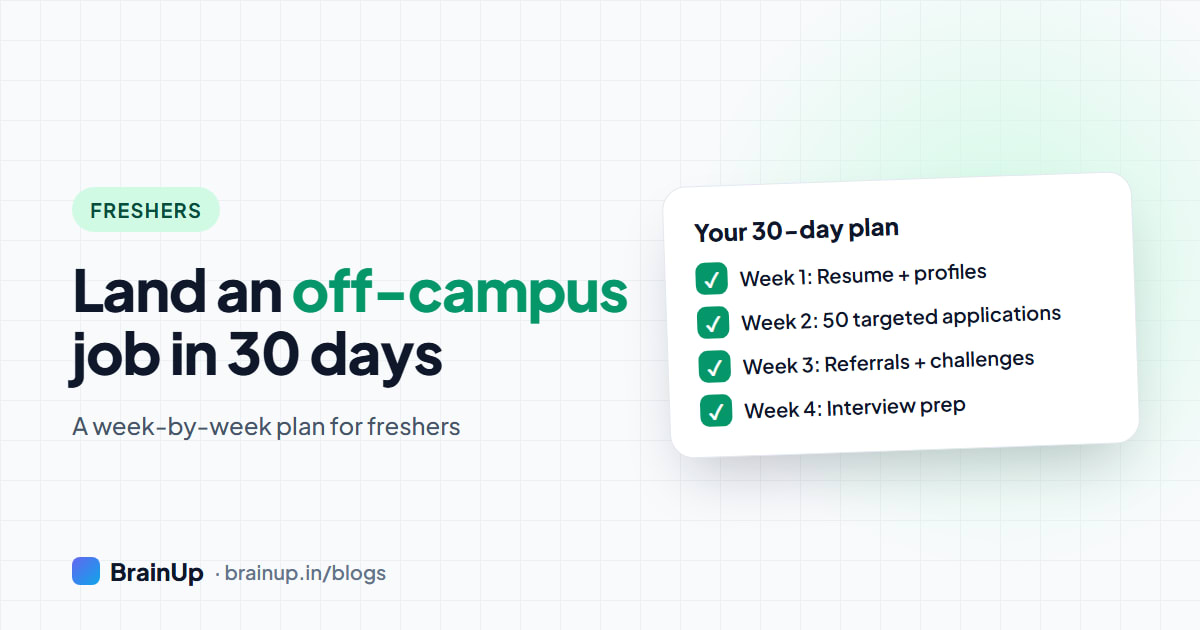
Week 1: Foundation
- Pick one or two target roles. “Any IT job” is not a target. “Junior Python developer” or “Data analyst trainee” is.
- Build one resume per target role. Projects first, with tools and outcomes. Use our resume for freshers guide or the B.Tech fresher resume guide.
- Update your profiles: LinkedIn headline with your target role, job portal profiles with key skills, GitHub or portfolio with your best two projects. A simple portfolio website helps for tech and design roles.
- Make a list of 40–60 target companies that hire freshers for your role.
Week 2: Apply through portals and careers pages
- Set job alerts with fresher filters on major portals and LinkedIn.
- Check careers pages of your target companies directly; some roles are posted there first.
- Apply to 8–10 roles a day, each with your tailored resume.
- Log every application: company, role, date, link, status.
Week 3: Referrals and hiring challenges
- Referrals: message alumni and connections at your target companies. Our guide on how to ask for a referral has templates.
- Hiring challenges: many companies hire freshers through coding contests, hackathons and case competitions. Register for the ones relevant to your role.
- Keep applying to 5–8 roles a day.
Week 4: Interviews and follow-ups
- Follow up politely on applications older than 10 days where you have a contact.
- Prepare for aptitude tests, technical basics and HR questions. Start with interview questions for freshers.
- Review your tracker: which channel produced responses? Do more of that.
The four channels compared
| Channel | Effort | Typical response | Best for |
|---|---|---|---|
| Job portals | Low per application | Low, high volume | Broad coverage |
| Company careers pages | Medium | Medium | Target companies |
| Referrals | High | Higher | Companies where you know someone |
| Hiring challenges | High | Depends on your score | Tech, analytics, consulting roles |
Response levels are general patterns, not guarantees; they vary by role and market.
If your CGPA is below the cut-off
Many companies filter on CGPA, often at 6 to 7. If you are below it:
- Target startups and mid-size companies that hire on skills.
- Use hiring challenges, where performance matters more than marks.
- Lead your resume with projects, internships and certifications.
- Get referrals; a human reviewer may look past a strict filter.
Daily routine (about 3 hours)
| Time | Task |
|---|---|
| 45 min | Find and apply to 5–10 relevant roles |
| 30 min | Networking: 3–5 referral or alumni messages |
| 60 min | Skill practice: coding, aptitude, Excel or domain basics |
| 30 min | Interview practice: one HR and one technical question out loud |
| 15 min | Update your application tracker |
Mistakes that waste weeks
- Sending the same generic resume everywhere
- Applying only on weekends in big batches
- Not tracking applications, then forgetting follow-ups
- Paying anyone who promises a guaranteed job
- Ignoring smaller companies and startups
Track every application in one place
Log companies, roles, dates and follow-ups in BrainUp’s Job Application Tracker so nothing slips during your 30 days.
Open the Job TrackerKey takeaways
- Pick one or two target roles and tailor your resume to them.
- Use four channels: portals, careers pages, referrals and hiring challenges.
- Apply a little every day and track everything.
- With a low CGPA, lead with projects and skill-based hiring.
Frequently asked questions
Is off-campus placement very hard?
It is more competitive than campus hiring because you compete with graduates from many colleges. It becomes manageable with a targeted resume, consistent applications every day, and referrals.
Is 7 CGPA good for off-campus placement?
Many companies use 6, 6.5 or 7 as cut-offs, so 7 clears most filters. With a lower CGPA, focus on companies without strict cut-offs, startups, and skill-based hiring challenges, and let projects carry your resume.
Where can freshers find off-campus jobs?
Company careers pages, job portals with fresher filters, LinkedIn job alerts, college alumni networks, and coding or case competitions that companies use for hiring.
How many applications should a fresher send?
Quality matters more than volume, but a steady pace helps. Ten tailored applications a day for a few weeks is far more effective than 200 identical ones in a weekend.
Which is better, on-campus or off-campus placement?
On-campus is easier if good companies visit your college. Off-campus gives you a wider choice of companies and roles. Most freshers benefit from doing both.