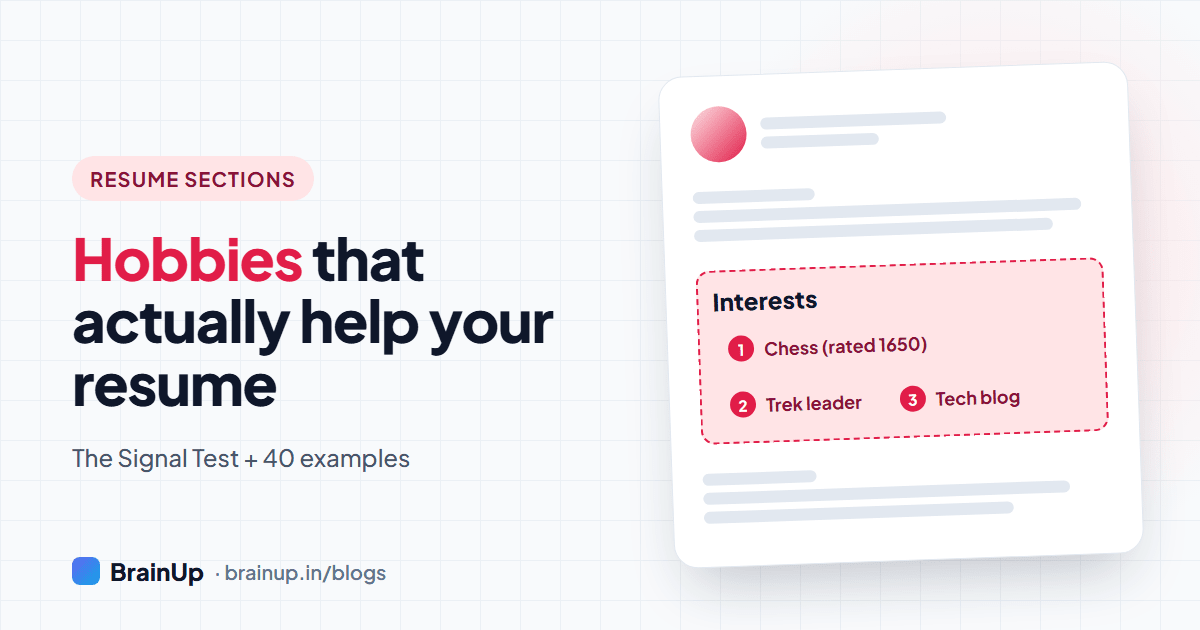
Short answer: List two to four hobbies only if they say something useful about you, such as a skill, discipline or achievement, and make each one specific (“State-level chess player, rated 1650” instead of “Chess”). Freshers benefit most; experienced candidates can usually skip the section.
“Reading, travelling, listening to music.” That line appears on thousands of resumes every day. It is not wrong, but it tells the recruiter nothing, and it occupies space that could hold something that gets you an interview.
Hobbies can help, especially for freshers. They can show discipline, leadership or skills that are hard to prove elsewhere. The trick is choosing the right ones and writing them specifically.
Should you include hobbies at all?
| You are… | Recommendation |
|---|---|
| A fresher or student with limited experience | Include 2–4 strong ones |
| Applying to a role where a hobby shows a related skill | Include that hobby |
| Applying to a company with a strong culture fit focus | Include if genuine |
| Experienced, with a full page of results | Usually skip |
| Short of space on a one-page resume | Skip |
The Signal Test
Before you list a hobby, check it against three questions. Keep it only if it passes at least two.
- Specific: does it say what, how much or how well?
- Relevant: does it show a skill or trait the job values?
- Real: could you talk about it confidently for two minutes in an interview?
Generic vs specific
| Generic | Specific |
|---|---|
| Reading | Reading business biographies; write short summaries on my blog |
| Travelling | Planned and led a 6-day trek in Himachal for 12 college friends |
| Sports | Played inter-college cricket for 3 years; captain in final year |
| Music | Self-taught guitarist; performed at two college fests |
| Cooking | Run a small weekend tiffin service for hostel students |
| Social media | Manage a 3,000-follower Instagram page on street food in Indore |
| Gaming | Organised an online BGMI tournament with 40 teams |
These are illustrative. Use your real details and numbers.
Hobbies that fit different roles
| Role | Hobbies that send a useful signal |
|---|---|
| Software / IT | Open-source contributions, competitive programming, building side projects, tech blogging, hackathons |
| Data / analytics | Kaggle competitions, sports statistics, puzzles, chess, personal finance tracking |
| Sales / business development | Debating, team sports, event organising, running a small business, public speaking clubs |
| Marketing / content | Blogging, running social media pages, photography, video editing, podcasting |
| Design | Sketching, photography, UI redesign challenges, crafts, typography projects |
| Finance / accounts | Stock market tracking (paper trading), chess, Sudoku, budgeting projects |
| Teaching / HR | Volunteering with NGOs, mentoring juniors, tutoring, organising community events |
| Operations / logistics | Trek or trip planning, event management, organising college fests |
Hobbies to avoid
- Very generic ones on their own: watching movies, sleeping, browsing the internet, chatting with friends.
- Divisive topics: political or religious activities, unless directly relevant to the role.
- Risky or controversial pursuits that may raise questions you do not want in an interview.
- Anything you cannot talk about. If it was added to fill space, it will show.
How to format the section
Interests
- Competitive programming: 3-star on CodeChef
- Inter-college football: played as goalkeeper for 2 years
- Volunteer tutor for Class 10 maths at a local NGO
- Place it near the end, after skills and projects.
- Use a heading like “Interests” or “Hobbies and Interests”.
- One line per hobby, with one specific detail each.
For other sections freshers often struggle with, see our guides to resume skills examples, the declaration section, and making a resume without experience.
Build a fresher resume that fills the page with signal
Add projects, skills and interests in BrainUp’s free Resume Builder and download it as PDF.
Open the Resume BuilderKey takeaways
- List 2–4 hobbies, only if they add a useful signal.
- Make each specific: what, how much, how well.
- Match hobbies to the role where you can.
- Experienced candidates can usually drop the section.
Frequently asked questions
Should I include hobbies in my resume?
Include them if you are a fresher with space to fill, or if a hobby shows a skill relevant to the job. Experienced candidates with a full page of results can usually leave them out.
How many hobbies should I list?
Two to four. More than that looks like filler, and each one should pass the Signal Test.
What is the “3 hobby rule”?
It is popular advice to have three hobbies: one that earns money, one that keeps you fit, and one that is creative. It is life advice rather than a resume rule. On a resume, list only hobbies that say something useful about you.
Are reading and travelling good hobbies for a resume?
Only if you make them specific. “Reading” says little; “Reading business biographies; I write a monthly summary on my blog” says much more.
Where should hobbies go on a resume?
Near the end, after education, skills and projects, under a heading like “Interests” or “Hobbies and Interests”.