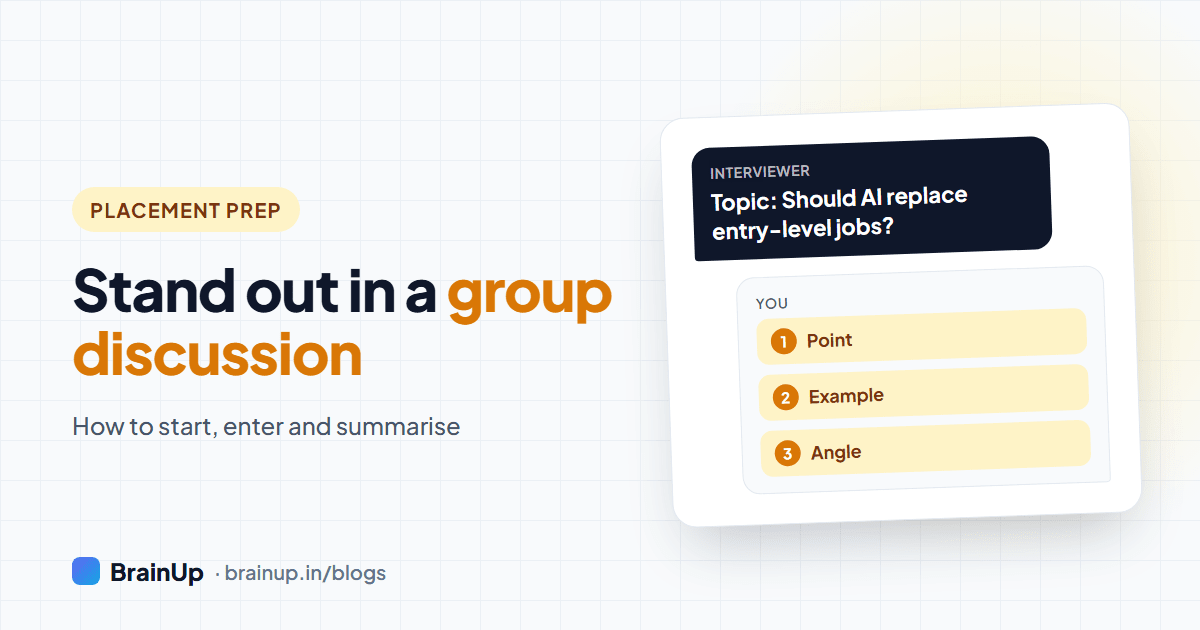
Short answer: Evaluators score content, communication, listening and leadership, not volume. Make three or four well-structured points (point, example, a new angle), build on others by name, bring quieter members in, and offer a balanced summary at the end. Starting is optional; starting badly is worse than starting second.
Ten candidates, one topic, fifteen minutes, and an evaluator taking notes. Within thirty seconds, three people are talking at once and you are still waiting for a gap. When you finally speak, someone cuts you off.
Group discussions reward a few specific behaviours that most candidates never practise. Once you know what is being scored, you can stop competing for airtime and start earning marks.
What evaluators actually score
| Criterion | What earns marks | What loses marks |
|---|---|---|
| Content | Relevant points, examples, facts you are sure of | Vague opinions, made-up statistics |
| Communication | Clear, concise, calm voice | Rambling, jargon, shouting |
| Listening | Building on others’ points by name | Repeating what was already said |
| Leadership | Steering back to topic, bringing others in | Dominating, interrupting constantly |
| Attitude | Respectful disagreement | Personal attacks, eye-rolling |
Exact criteria vary by company, but these five appear in most GD rounds.
The PEAS contribution
Structure every time you speak:
- Point: one clear statement.
- Example: a real-world example, case or everyday observation.
- Angle: what this means, or a perspective nobody has raised yet (a different stakeholder, region, or time frame).
- Summary (only at the end of the GD): balance both sides.
“I think a hybrid model works better than fully remote. (Point) Many IT companies in Bengaluru moved to two or three office days after the pandemic. (Example) And if we look at it from a fresher’s view, in-person time is where most learning from seniors happens, which a fully remote setup makes harder. (Angle)”
How to start a GD: 12 opening lines
Only start if you have a clear opening. These are templates; adapt them to the topic.
Definition
- “Before we take sides, it might help to define what we mean by ‘[term]’…”
- “The topic has two key words, [X] and [Y]. Let me start with what each means here.”
Context
- “This topic matters right now because…”
- “Over the last few years, we’ve seen [trend], which makes this debate important.”
Question
- “The real question here might be: who benefits and who pays?”
- “Should we look at this from the government’s view, the industry’s, or the citizen’s?”
Example or story
- “Let me start with a simple example from daily life…”
- “Think of a small shop owner in a tier-2 city; for them, this topic means…”
Balanced framing
- “There are strong arguments on both sides, so let me lay out the main ones.”
- “I’d like to suggest we look at short-term and long-term effects separately.”
Structure for the group
- “Maybe we can cover economic, social and practical aspects, one by one.”
- “Could we first list the key stakeholders before debating?”
Useful phrases during the discussion
| To… | Say |
|---|---|
| Enter | “Building on what Riya said…” / “I’d like to add one point here.” |
| Agree and extend | “I agree, and another reason is…” |
| Disagree politely | “I see it differently. Consider…” / “That’s valid in cities, but in rural areas…” |
| Bring someone in | “Arjun, you started to say something earlier. What’s your view?” |
| Steer back | “We’ve moved a little away from the topic. Coming back to…” |
| Calm a fight | “Both points are valid. Maybe the answer depends on…” |
How to summarise
“To summarise, we discussed [topic] from [two or three angles]. Those in favour argued [main point], while others raised [counterpoint]. Most of us seemed to agree that [common ground]. So overall, [balanced conclusion].”
A summary should be neutral and short. Do not add new arguments or push only your own side.
Common mistakes
- Speaking first without a point, just to be first
- Interrupting mid-sentence repeatedly
- Staying silent for the first ten minutes
- Addressing the evaluator instead of the group
- Repeating someone else’s point as your own
Practise in a week
- Gather 4–6 friends and pick a topic each day.
- Run a 10-minute GD with one person observing and scoring with the table above.
- Record it on a phone; listen for filler words and interruptions.
- Rotate who starts and who summarises.
GDs are usually followed by personal interviews. Prepare your “Tell me about yourself” answer and other interview questions for freshers. If you are applying beyond campus, our off-campus job plan helps.
Prepare for the interview after the GD
Practise HR and technical questions for your target role with BrainUp’s AI Interview Prep (beta).
Try AI Interview PrepKey takeaways
- Evaluators score content, communication, listening, leadership and attitude.
- Use Point–Example–Angle for each contribution.
- Build on others by name and bring quiet members in.
- Finish with a short, balanced summary.
Frequently asked questions
Is it necessary to start the group discussion?
No. Starting well earns credit, but starting badly hurts. If you know the topic and have a clear opening, start. Otherwise, make the second or third strong point.
How many times should I speak in a GD?
There is no fixed number. Three or four meaningful contributions in a 15-minute GD are usually enough. Quality and relevance matter more than airtime.
What if I don’t know anything about the topic?
Listen for the first minute, then build on someone else’s point with a question, an example from daily life, or a different stakeholder’s view. You can contribute without being an expert.
How do I enter when everyone is talking at once?
Wait for a brief pause, start with a bridging phrase like “Building on that point…”, and speak clearly at a slightly higher volume. Do not shout over others.
Should I summarise at the end?
If the moderator asks for a summary, or the group is wrapping up, a balanced summary that covers both sides is a strong finish. Do not introduce new points in it.