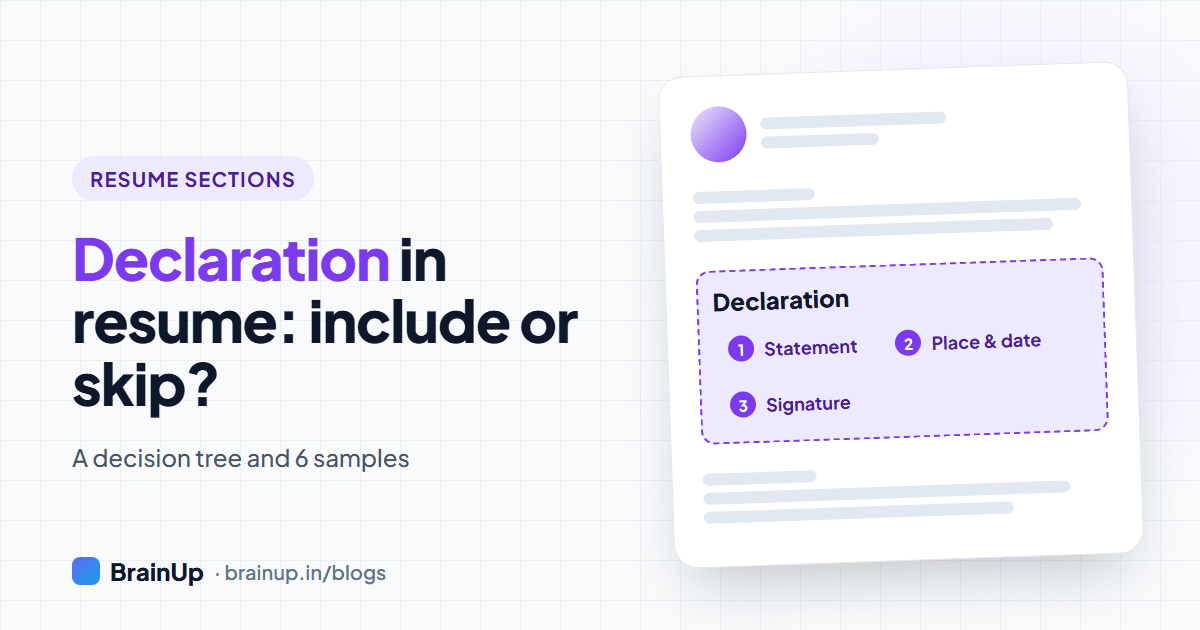
Short answer: A declaration is a one-line statement at the end of a resume confirming that the information is true, followed by place, date and your name. Include it for government, PSU and some traditional Indian employers. Skip it for most private-sector, startup and international applications, where it uses space without adding value.
Ask ten people whether a resume needs a declaration and you will get two confident, opposite answers. Your college placement cell may insist on it. A recruiter at a Bengaluru startup may call it outdated. Both are right, for different employers.
This guide helps you decide, then gives you samples you can copy.
What a declaration looks like
Declaration
I hereby declare that the information furnished above is true to the best of my knowledge and belief.
Place: Jaipur
Date: 27/10/2026
(Rohit Meena)
Include-or-Skip Decision Tree
| Where you are applying | Declaration? | Why |
|---|---|---|
| Central or state government, PSU, public sector bank | Include | Commonly expected; printed applications are still common |
| Schools, colleges, hospitals, traditional family businesses | Include | Many still follow conventional formats |
| Campus placement where the cell gives a format | Follow the format | The template wins |
| Private companies, MNCs, IT services | Optional, usually skip | Not expected; space is better used for skills or projects |
| Startups and product companies | Skip | Looks dated; recruiters scan for impact |
| Jobs outside India | Skip | Not a convention abroad |
6 declaration samples
I hereby declare that the information furnished above is true to the best of my knowledge and belief.
I hereby declare that all the details mentioned above, including my academic records, are correct and true to the best of my knowledge.
I hereby declare that the information provided above, including my employment details, is true and complete to the best of my knowledge.
I hereby declare that the particulars given above are true and correct to the best of my knowledge and belief, and that I will produce the original documents for verification whenever required.
I confirm that the information above is accurate.
I hereby declare that the above information is correct. I understand that if any information is found to be false, my candidature is liable to be cancelled.
How to format it
- Place it as the last section, after education, skills and personal details.
- Use the heading Declaration, styled like your other section headings.
- Write one or two lines; do not repeat it in the cover letter.
- Add Place and Date on the left and your name or signature on the right.
- For printed copies, sign in blue or black ink above your typed name.
What not to write
“I hereby solemnly declare and affirm on oath…” (affidavit language) · Long paragraphs promising to work hard · A declaration that contradicts your details, such as a wrong date · Leaving the place and date as “______”
Does it affect ATS?
No meaningful effect. Applicant tracking systems scan for skills, titles and experience. A declaration neither helps nor hurts parsing, which is why the only real cost is space.
Building a resume for the Indian market? Our resume format for India covers personal details, photo and declaration conventions together. Freshers can also check the resume for freshers guide and whether to add hobbies.
Build a clean resume for any employer
Create your resume in BrainUp’s free Resume Builder, choose a template that suits Indian or international applications, and download it as PDF.
Open the Resume BuilderKey takeaways
- Include a declaration for government, PSU and traditional employers.
- Skip it for startups, most private companies and jobs abroad.
- Keep it to one or two lines, at the end, with place, date and name.
- Drop it if it pushes your resume to a second page.
Frequently asked questions
Is a declaration mandatory in a resume?
No. It is optional for most private-sector jobs. Some government, PSU and traditional Indian employers still expect it, and some application forms require a signed declaration separately.
Where should the declaration go in a resume?
At the very end, after all other sections, followed by place, date and your name or signature.
Should I add a declaration for jobs abroad?
No. Employers in the US, UK, Europe, Canada and the Gulf generally do not expect it, and it can make the resume look dated.
Do I need to sign the declaration?
For printed or scanned submissions, sign above your name. For digital applications, your typed name is usually enough unless the employer asks for a signature.
Is a declaration different for freshers and experienced candidates?
The wording is almost the same. Freshers sometimes mention that their academic details are correct; experienced candidates may mention employment details. Keep it to one or two lines either way.