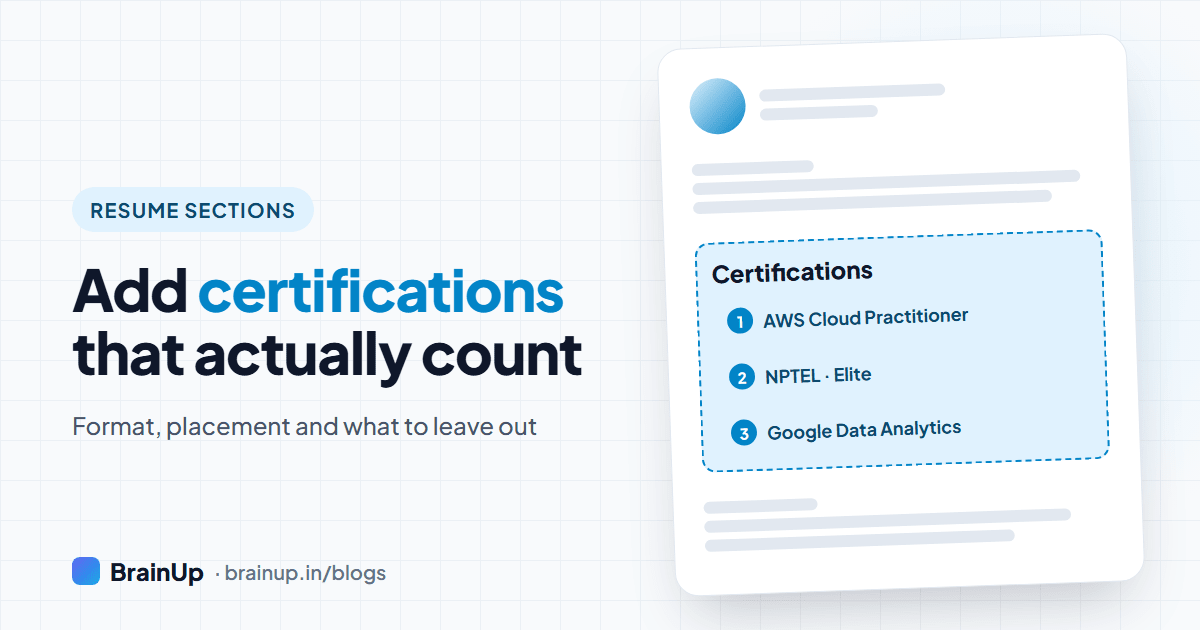
Short answer: Create a separate “Certifications” section and list each one as: certification name, issuing organisation, month and year (and a credential ID or link if available). Include only certifications relevant to the job, put the most valuable first, and for freshers place the section right after education.
Online courses have made certificates easy to collect. Many freshers end up with fifteen of them: three from NPTEL, a few from Coursera, a Google certificate, and a long tail of short Udemy courses. Then the question is which ones belong on a one-page resume, and where.
The answer depends on how much each certificate proves and how relevant it is to the job.
Certificate Value Tiers
| Tier | Examples | How recruiters tend to read it |
|---|---|---|
| 1. Licences and proctored industry exams | CA, CFA levels, AWS / Azure / Google Cloud certifications, PMP, CCNA, Salesforce certifications | Strong proof of a standard; often a requirement |
| 2. Structured programmes with assessments | NPTEL (with exam score), multi-course professional certificates on Coursera or edX, university-backed programmes | Good evidence of learning, especially for freshers |
| 3. Short course completions | Single Udemy or YouTube-style courses, short workshops | Shows interest; carries weight only with a project |
| 4. Unrelated certificates | Courses unrelated to the target role | Usually adds noise; leave out |
How much a certificate counts also depends on the role and employer. Use the tiers as a guide for ordering and pruning, not as a fixed ranking.
The format
[Certification name] — [Issuing organisation] | [Month Year] | [Credential ID or short link]
Certifications
- AWS Certified Cloud Practitioner — Amazon Web Services | Aug 2026 | ID: ABC123XYZ
- Programming, Data Structures and Algorithms using Python — NPTEL (IIT Madras) | Elite | Apr 2026
- Google Data Analytics Professional Certificate — Google via Coursera | Jan 2026
Where to put the section
| Your situation | Placement |
|---|---|
| Fresher, little experience | Right after Education, before Projects or alongside them |
| Experienced | After Experience and Skills |
| Certification is required for the job | Also mention it in the summary or headline |
| Career switcher | High up, since it bridges the gap; see the summary too |
Turn a certificate into proof
A certificate says you completed a course. A project says you can use what you learned. Where possible, pair them:
Google Data Analytics Certificate — Coursera | 2026
Projects: Analysed 2 years of public bike-share data in SQL and built a Tableau dashboard on peak usage, as the capstone of the Google Data Analytics Certificate.
See resume action verbs for strong ways to start those bullets.
Special cases
In-progress certifications
List them with “In progress” or “Expected Dec 2026”. Only do this if you will finish soon; interviewers may ask about the content.
Expired certifications
Leave them out, or list with the validity period if the experience still matters. Never present an expired certification as current.
Certificates of participation
Webinar and event participation certificates rarely belong in Certifications. Hackathon wins or competition ranks fit better under Achievements.
Certifications and ATS
Many job descriptions name specific certifications. Write them exactly as the employer does (for example “AWS Certified Solutions Architect – Associate”, not “AWS architect cert”) so an ATS keyword match works. Our guide to ATS keywords from a job description explains how to find these terms.
Mistakes to avoid
- Listing every course you ever started
- Mixing certifications into the Skills section with no issuer or date
- Abbreviations recruiters may not recognise
- Claiming a certification you did not complete; most can be verified
Certifications work best alongside a clear skills section; see our resume skills examples. Freshers can follow the full resume for freshers guide.
Add a clean Certifications section
Build your resume in BrainUp’s free Resume Builder, add certifications in a consistent format, and download an ATS-friendly PDF.
Open the Resume BuilderKey takeaways
- Use a separate Certifications section: name, issuer, date, ID.
- List only relevant certifications, most valuable first.
- Freshers: place it right after Education.
- Pair course certificates with a project to prove the skill.
Frequently asked questions
Where should certifications go on a resume?
In a separate Certifications section, usually after skills or education. Freshers with little experience can place it higher, just below education. If a certification is required for the job, mention it in your summary too.
Should I add Udemy or Coursera certificates to my resume?
Add them if they are relevant to the job and you can show what you learned, ideally through a project. Skip unrelated or very short courses.
How do I list a certification I am still completing?
Add “In progress” or “Expected [Month Year]” after the name. Only list it if you will actually finish soon.
Should I add a certificate link or ID?
Yes, if there is a verification link or credential ID. It lets recruiters confirm it quickly. Keep the link short.
How many certifications should I list?
Three to six relevant ones is plenty for most people. A long list of unrelated certificates can look like padding.