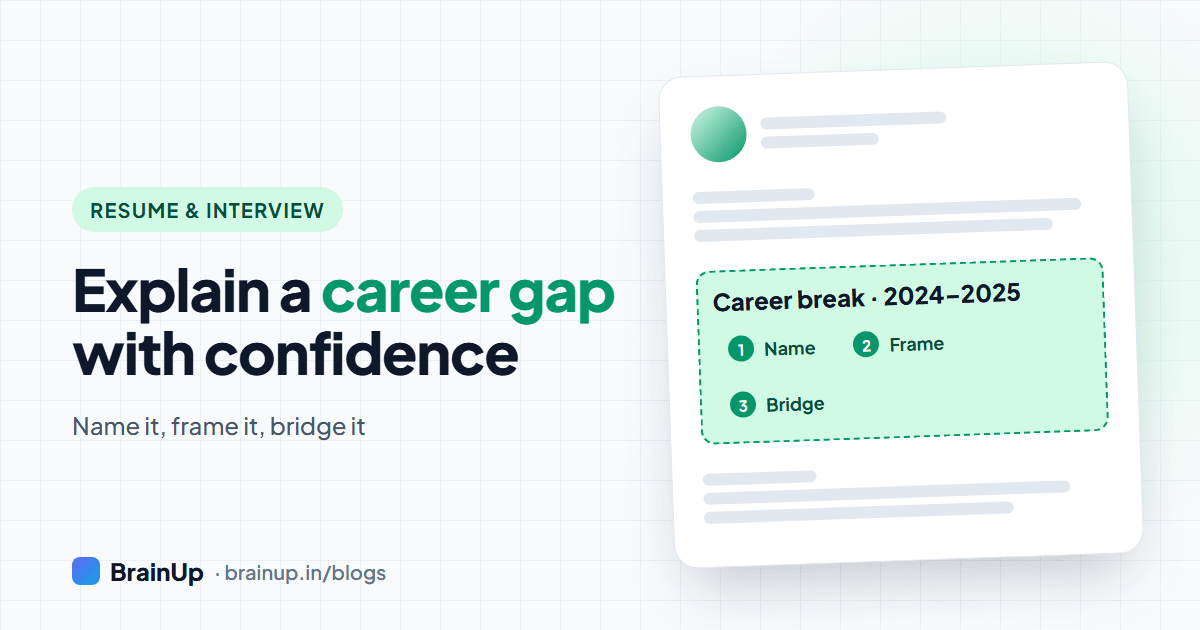
Short answer: Name the gap honestly in one sentence, frame what you did or learned during it, and bridge to why you are ready for this role now. On the resume, list it as a short, labelled entry instead of hiding it.
A gap in your resume can feel like a red stamp. You took a year to prepare for UPSC, cared for a parent, recovered from an illness, or got caught in a layoff, and now every application asks you to account for those months.
Recruiters are less worried about the gap itself than about two questions it raises: why did it happen, and are you ready to work now? If you answer both clearly, most gaps stop mattering.
The Name–Frame–Bridge method
| Step | What to say | Length |
|---|---|---|
| Name | The reason, plainly, without over-explaining | 1 sentence |
| Frame | What you did, learned or kept up during the gap | 1–2 sentences |
| Bridge | Why you are ready now and why this role fits | 1 sentence |
That is about 30 seconds. A longer explanation sounds defensive.
Sample answers by type of gap
Illustrative answers. Use only what is true for you.
Exam preparation (UPSC, CAT, GATE, bank exams)
“After graduation I spent a year preparing for the civil services exam. I didn’t clear it, but the preparation built strong discipline and gave me a good grounding in economics and current affairs. I’ve decided to build my career in financial analysis, which uses those strengths, and I completed an Excel and financial modelling course last quarter.”
Family responsibilities
“I took 14 months off to care for a family member. That situation is now stable, and I have full-time support at home. During the break I kept up with the industry and refreshed my SQL with an online course, so I’m ready to get back to analytics work.”
Health
“I took time off for a health matter that is now fully resolved. I’m back to full capacity and keen to return to client servicing, where I worked for three years before the break.”
Layoff and job search
“My role was cut in a company-wide restructuring in March. Since then I’ve been selective about my next role and used the time to complete an AWS certification. This position matches what I was looking for.”
Fresher gap year
“After my B.Com I took a year to figure out my direction. I tried a few things, including helping with accounts at a family business, and realised I enjoy working with numbers and clients. That’s why I’m applying for this accounts executive role.”
Parental leave or caregiving for a child
“I took two years off after my child was born. I’m now ready to return full-time and have childcare arranged. I’ve spent the last few months updating my skills in the latest version of our design tools.”
How to show the gap on your resume
Treat the gap like a short job entry. It removes the mystery and stops the recruiter from guessing.
Career Break | Jan 2024 – Mar 2025
Family caregiving. Completed Google Data Analytics Certificate; built two portfolio dashboards on public sales data.
Stretching the dates of your previous job, or listing only years (“2022–2024”) to blur the gap. Background checks catch both.
Which format to use
- Reverse-chronological works for most people. Put the gap in its correct place in your experience section.
- Hybrid (a short skills summary on top, then experience) suits longer gaps or career changes. See our career change resume guide.
- Functional resumes that drop dates entirely tend to make recruiters more suspicious, not less.
Close the gap with recent proof
The strongest bridge is evidence that you are current. Pick one or two of these:
- A recent course or certification relevant to the role
- A small project or portfolio piece you can show
- Freelance, part-time or volunteer work, even if unpaid
- Helping in a family business, with specific responsibilities
Handling follow-up questions
| If they ask | You can say |
|---|---|
| “Why didn’t you work part-time during the gap?” | “My priority was [reason]. I kept my skills current through [course/project].” |
| “Could this happen again?” | “The situation is resolved and I have support in place, so I can commit fully.” |
| “Are your skills out of date?” | “I refreshed them with [specific]. Here is something I built recently.” |
Rebuild your resume with the gap handled
Use BrainUp’s free Resume Builder to add a labelled career break and highlight your recent skills.
Open the Resume BuilderIf you are restarting with little work history, our guide to making a resume without experience may also help. Returning professionals can check the resume format for experienced candidates.
Key takeaways
- Name the reason in one sentence, without apologising.
- Show what you did or learned during the gap.
- Bridge to why you are ready for this role now.
- List the gap on your resume instead of hiding it.
Frequently asked questions
Should I hide a career gap on my resume?
No. Gaps are easy to spot from dates, and hiding one makes it look like a problem. List it briefly with a neutral label such as “Career break: family responsibilities” and be ready to explain.
How do I justify a gap year as a fresher?
Say what you did with the year in one sentence (exam preparation, health, family, a skill course), mention anything you learned or built, and say why you are now focused on this job.
How long a gap is too long?
There is no fixed limit. What matters is a clear reason and evidence you are ready now, such as recent courses, projects or freelance work.
Do I have to share personal details like health issues?
No. “I took time off for a health matter that is now resolved” is enough. You are not obliged to share medical details.
Should I use a functional resume to hide a gap?
Usually not. Many recruiters distrust functional resumes. A reverse-chronological or hybrid format with the gap clearly labelled works better.